
Every evening at Sabarimala — and in Ayyappa temples around the world — the doors of the sanctum close to the sound of one song: Harivarasanam. This eight-stanza ashtakam, composed in highly Sanskritised Malayalam, is perhaps the most moving devotional piece in the entire tradition of Ayyappa bhakti.
“Harivarasanam Viswamohanam, Haridadhiswaram Aaradhyapadhukam — Repository of Hari’s boons, Enchanter of the universe, Essence of Hari’s grace, He whose holy feet are worshipped…”
The Origin of Harivarasanam
The song was composed by Kambamgudi Kulathur Iyer and was first sung by Swami Vimochanananda at Sabarimala. Though many renowned vocalists have recorded their own versions, Sabarimala plays the rendition by Padmashri Dr. K. J. Yesudas every evening after the final pooja — a tradition that has continued unbroken for decades.
The story of how Harivarasanam became the closing lullaby of Sabarimala is deeply touching. A devoted caretaker named Gopala Menon from Alapuzha used to recite Harivarasanam with complete devotion during his years at Sabarimala. When he passed away, Thirumeni Eashwaran Namboothiri, who had heard of his passing, was about to close the doors of the Sannidhanam when he remembered Gopala Menon’s dedication. He began to recite Harivarasanam — and felt a divine presence, as if Lord Ayyappa himself was guiding the singing. A tradition was born that night, and has not been broken since.
The Meaning of the Song
Harivarasanam is an ashtakam — a hymn of eight stanzas. Each stanza addresses Lord Ayyappa (Hariharatmaja — son of Hari and Hara) with a series of divine epithets, concluding with the universal refuge: Saranam Ayyappa.
🎵 A Few Lines in Translation
Harivarasanam Viswamohanam — Repository of Hari’s boons, Enchanter of the universe
Haridadhiswaram Aaradhyapadhukam — Essence of Hari’s grace, He whose holy feet are worshipped
Arivimardhanam Nithyanarthanam — He who destroys enemies of wisdom, He who dances eternally
Hariharathmajam Devamashraye — Son of Hari and Hara, I take refuge in thee
Saranam Ayyappa — My refuge is in you, Ayyappa
Why It Is Sung at Closing
The song is a lullaby — it is sung to put the Lord to sleep at the end of the day’s worship. The closing of the sanctum doors at Sabarimala and at our temple in Jaipur is not a departure but a sacred tucking-in — the priests withdrawing as the final words of the lullaby echo through the temple, leaving the Lord in divine repose until the next morning’s Palli Unarthal (the ritual awakening).
“As the last verse fades and the doors close, the devotees stand in silence — knowing that what remains inside is not stone, but the living presence of Lord Ayyappa.”
At Shree Ayyappa Temple, Jaipur
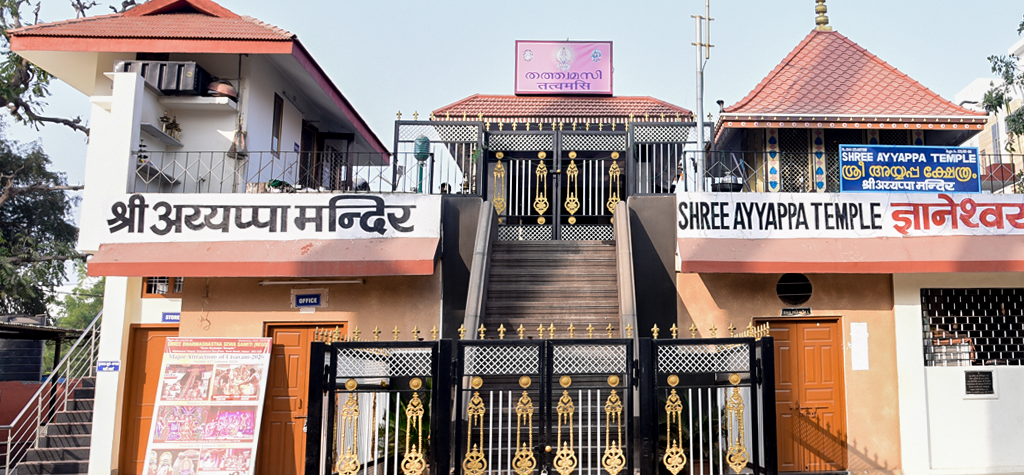
Every evening at our temple, Harivarasanam is sung during the closing Deeparadhana before the temple doors shut. Devotees are welcome to gather for this profoundly moving moment. The Saturday evening Bhajana programme regularly includes a group rendition of Harivarasanam — a communal experience of devotion that fills the entire temple premises with its grace.